
Read
Employee Spotlight: Barry Coulling, Head of Manufacturing
3 Jul 2025
At Oxford Ionics, we believe that building the world’s most powerful quantum computers starts with the talented individuals behind the technology. Our team consists of 100 people operating at the very cutting-edge of their fields, all working towards our mission to deliver game-changing quantum computers to our customers. In this blog series, we’re highlighting some of the individuals who are making this mission a reality.
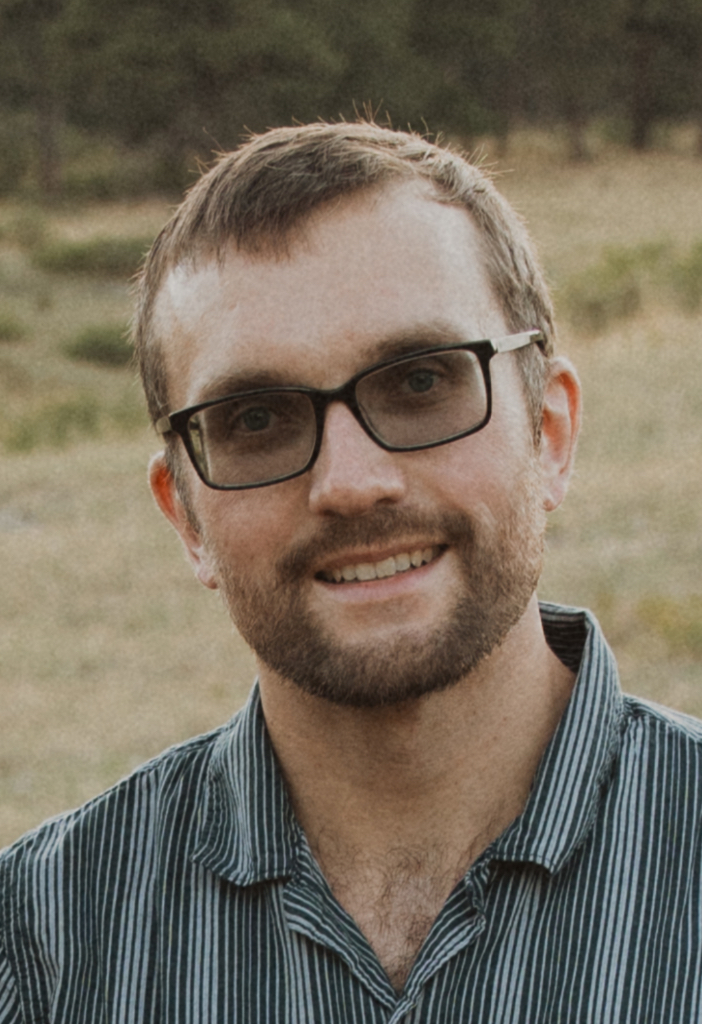
Today, we’re introducing Steven Moses, Principal Quantum Scientist. Based in our Boulder office, Steven brings a wealth of expertise across different quantum computing modalities and architectures that he will apply as we build our 256-qubit devices and beyond. Read on to learn more about Steven’s background, why he joined Oxford Ionics, and the project he’s most excited to tackle next.
I started my career in quantum science while completing my PhD at CU Boulder, where I studied ultracold polar molecules in the groups of Professors Jun Ye and Debbie Jin. One of the main goals of this project was to perform quantum simulations of systems that have long-range interactions. These molecules undergo chemical reactions, even at ultracold temperatures, which is a problem or a feature depending on your perspective. We studied how to control these chemical reactions by changing variables like temperature and the geometry in which the molecules collide. About midway through my PhD, we published a paper that demonstrated spin exchange interactions in polar molecules, which paved the way for recent demonstrations of entangling gates with polar molecules. During my time on this project, I felt like we only scratched the surface of what is possible to study with these systems. Nevertheless, the continued progress kept me both optimistic and motivated to continue working on using well-controlled quantum systems to simulate more complex physical phenomena and potentially solve classically intractable problems.
Right around when I graduated, there was an uptick in interest in quantum computing research, as multiple modalities were starting to achieve very impressive results. I sensed that it would be an exciting field to be a part of, so I went to the Joint Quantum Institute and University of Maryland to do a postdoc with Professor Chris Monroe, one of the pioneers of trapped-ion quantum computing. There I worked on a project to implement two-qubit gates in trapped ions by using a sequence of ultrafast laser pulses. This is a very different regime than what had typically been done in his group, where the laser was operated at low enough power that you could ignore the fact that the laser is pulsed. In principle, such a gate could be very fast (even faster than the ions’ motional period) and less sensitive to the ions’ temperature and other noise sources. We showed that such a gate works, but the fidelity wasn’t that great due to the relatively long spacing between laser pulses and challenges associated with high-power UV optics.
After my time at the University of Maryland, there was a bit of a paradigm shift, and I think there was a realization that building a large-scale quantum computer requires a lot more resources than the typical academic group is afforded. As a result, a lot of companies became interested in quantum computing. Wanting to move back to Colorado, I joined Honeywell Quantum Solutions, which eventually spun off and merged with Cambridge Quantum Computing to become Quantinuum. I was a member of the team that published a 2021 paper in Nature demonstrating the QCCD architecture (initially proposed by NIST) in a small six-qubit system. My work here was mostly focused on ion transport, which is necessary to achieve all-to-all connectivity of the qubits. More recently, I was the technical lead for Quantinuum’s H2 project, initially released with 32 qubits and then 56 qubits. The system had leading performance, and we were actually able to improve the fidelities as we increased the number of qubits, which showcases the scaling potential of the QCCD architecture. In this role, I was able to work cross-functionally with a range of teams including software engineers, project managers, and theoretical physicists.
After working on these projects for around 7 years, I wanted to explore a different quantum computing modality, so I joined the AWS Center for Quantum Computing at Caltech where I worked on superconducting qubits. There, I worked on the test and measurement team where we took newly-fabricated devices, calibrated them from scratch, and then determined if they were suitable for running Quantum Error Correction (QEC) experiments.
Having explored different modalities, including trapped ions and superconducting qubits, I realized first-hand that each has its pros and cons. I decided that trapped ions are the most promising modality given their unparalleled fidelity. I’m particularly interested in Oxford Ionics’ Electronic Qubit Control technology that leverages microwave gates instead of lasers, since I’ve seen first-hand the engineering challenges presented by laser-based gates.
Beyond that, I was very drawn to Oxford Ionics’ philosophy of simplifying as much of the engineering as possible. The rate of progress in this industry is so high, and it’s clear that the top players will need to scale quickly in order to understand what the next challenge will be on the path to fault-tolerant quantum computing. Oxford Ionics’ approach of building robust, simple, and economical systems seems the best way to tackle this.
I think the overwhelming thing that stands out about Oxford Ionics is its people. Of course everyone is friendly and supportive, but what I find so refreshing is that they really keep you honest when it comes to the technical details and ensuring that things are done correctly. The entire team really pushes you to challenge the assumptions you made in your previous work, and to ask yourself the hard questions: why is something done a certain way, what’s the purpose, and how will it integrate into the broader technology vision. The culture here is a really strong balance between this type of critical thinking and a healthy amount of skepticism to ensure we’re driving things towards achieving our technology goals in the most effective way possible.
I have just joined the company as Principal Quantum Scientist, and I am incredibly excited to hit the ground running. One of the things that I’ll be working on is taking the incredible foundational work already done by the team and start pushing the systems to hundreds of qubits and beyond. With these systems in place, we’ll not only be able to add more value for our customers but also be able to perform state-of-the-art QEC experiments. Beyond this, I am just looking forward to hitting the milestones on our development roadmap over the next few years. We have a strong path towards fault-tolerant quantum computing, and I am excited to start tackling the next phase of engineering required to get us there.
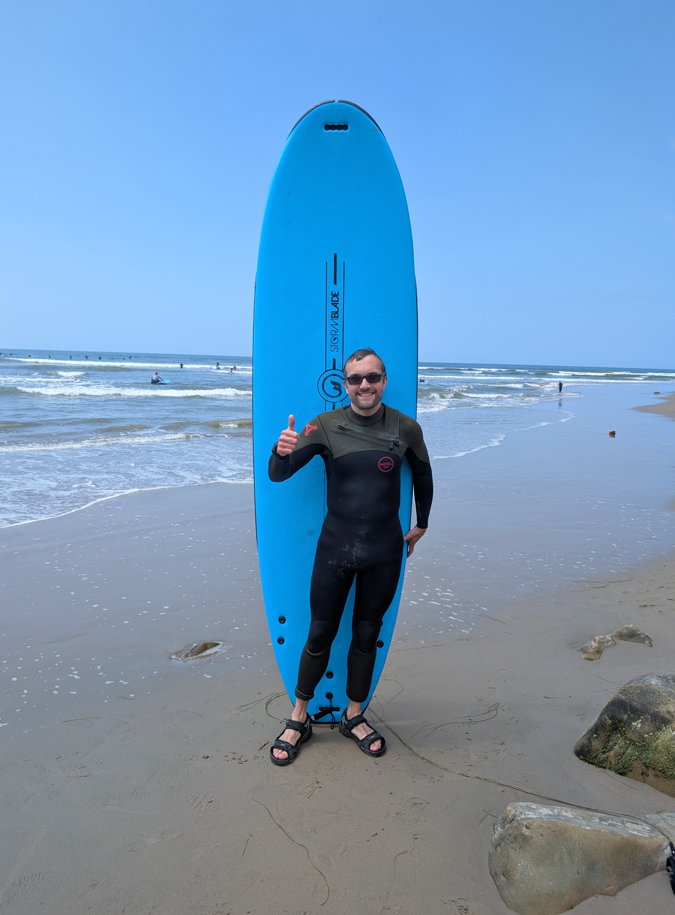
Definitely anywhere outside – I love spending time outdoors whether that’s hiking, running, skiing, cycling or climbing. Below is a picture of me on a recent surfing trip in California! Aside from outdoor activities, I spend a lot of time with my wife and dog. I also enjoy board games and salsa dancing.